Silverback Font Evaluation
In the expansive landscape of digital typography, finding a typeface that balances historical gravitas with modern legibility is a persistent challenge for designers. Silverback emerges as a distinct option within this niche, categorized primarily as an elegant and distinct blackletter font. For professionals researching, evaluating, or comparing font libraries for specific projects, understanding the precise characteristics and intended use cases of such specialized typefaces is crucial. This evaluation explores the structural qualities of Silverback, its potential applications, and the practical considerations one must weigh before integrating it into a design workflow.
Defining the Type: What Is Silverback?
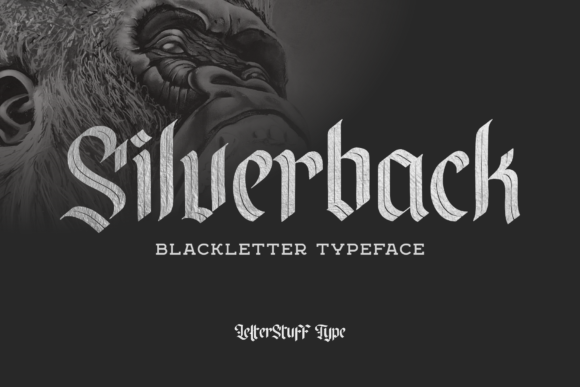
Silverback is not merely a decorative script or a casual handwritten style; it is firmly rooted in the tradition of blackletter, also known as Gothic or Old English typefaces. The description of Silverback as "neatly crafted and highly detailed" suggests a deliberate approach to stroke construction. Unlike some chaotic or overly ornate interpretations of calligraphy, a "neatly crafted" font implies consistency in weight, spacing, and terminal forms. This precision is vital for maintaining readability, even when using historically dense letterforms.
The term "elegant" in the context of blackletter often refers to the refinement of its proportions. While traditional blackletters can appear heavy and imposing, an elegant iteration typically features slightly more open counters (the enclosed spaces within letters like 'e' or 'a') and smoother transitions between thick and thin strokes. Silverback aims to capture this aesthetic, offering a visual identity that commands attention without sacrificing structural integrity. It is designed to be a versatile asset, capable of enhancing various creative outputs through its distinctive character.
Why Consider Silverback for Your Project?
Designers often seek out blackletter fonts to evoke specific cultural or historical associations. The primary reason to consider Silverback is its ability to convey authority, heritage, and craftsmanship. Whether for a brand logo, a concert poster, or a book cover, the presence of a well-executed blackletter font immediately signals a connection to tradition and solidity.
- Visual Distinctiveness: In a market saturated with sans-serif and geometric typefaces, Silverback offers immediate contrast. Its intricate details make it stand out in both print and digital environments.
- Cultural Resonance: Blackletter fonts are frequently associated with music genres like metal and punk, as well as academic institutions, breweries, and legal firms. Silverback allows these industries to tap into that visual language with a modern, refined twist.
- Detail-Oriented Aesthetic: The high level of detail mentioned in its description makes it suitable for large-scale displays where viewers can appreciate the nuances of the letterforms.
Benefits and Strengths
When evaluating Silverback, several benefits stand out for the discerning designer. First, its classification as an "asset to your font library" suggests versatility. While blackletter is often viewed as a display-only font, a neatly crafted version may offer enough clarity for short body text or pull quotes, provided the size is sufficient. The elegance of the design ensures that it does not feel archaic or clumsy; instead, it feels intentional and polished.
Furthermore, the potential to "enhance any creation" lies in its ability to serve as a focal point. When paired with simple, clean sans-serif fonts for secondary information, Silverback can anchor a layout effectively. This pairing strategy leverages the strength of the blackletter for headlines while relying on neutral typefaces for readability, creating a balanced typographic hierarchy.
Tradeoffs and Practical Considerations
Despite its strengths, there are significant tradeoffs to consider when incorporating Silverback into a project. The most critical factor is legibility. Blackletter fonts are inherently difficult to read at small sizes due to their density. If Silverback retains the high level of detail described, it may become muddy or illegible when scaled down below 14-16 points in most contexts. Designers must plan for its use in headers, logos, and large display text rather than paragraphs of copy.
Another consideration is kerning and spacing. Highly detailed fonts often require manual adjustment to look professional. Automated tracking might cause characters to collide or create uneven visual rhythms. Users should expect to invest time in fine-tuning the spacing between letters, especially in words with complex combinations of ascenders and descenders.
Additionally, the "distinct" nature of Silverback means it carries a strong voice. It cannot remain neutral. Using it for corporate communications, medical instructions, or any content requiring absolute clarity and neutrality would likely result in a mismatch between form and function. The font demands that the surrounding design elements support its boldness, which can limit its application in minimalist or understated designs.
Situational Fit: When to Use Silverback
Silverback is a strong fit for projects where mood and atmosphere are prioritized over rapid information consumption. Ideal scenarios include:
- Brand Identity for Heritage Brands: Breweries, distilleries, and artisanal product lines often use blackletter to signal quality and tradition.
- Event Posters and Tickets: Music festivals, particularly those in rock or metal genres, benefit from the aggressive yet elegant energy of blackletter.
- Educational and Institutional Logos: Universities and law firms may use such fonts to convey stability and long-standing reputation.
- Thematic Packaging: Products aiming for a vintage or gothic aesthetic, such as specialty coffees, candles, or apparel, can leverage Silverback’s detailed strokes to create premium packaging.
When to Look for Alternatives
There are clear situations where Silverback may not be the optimal choice. If the goal is to create a user interface (UI) element, a mobile app icon, or a navigation bar, the complexity of Silverback will hinder usability. Similarly, for editorial design involving long-form reading, such as blog posts or articles, a serif or sans-serif font with higher x-heights and simpler forms will serve the reader better.
If the project requires a friendly, approachable, or modern tech-forward tone, Silverback’s historical weight might feel out of place. In these cases, alternatives like clean humanist sans-serifs or soft rounded typefaces would align more closely with the desired emotional response. Additionally, if the budget or timeline does not allow for extensive kerning adjustments, a simpler blackletter variant with wider spacing might be a more practical decision.
Decision-Making Insights
To determine if Silverback aligns with your goals, start by defining the core message of your project. Ask whether you need to evoke tradition, strength, or intricacy. If yes, proceed to test Silverback at various scales. Create mockups of the intended final output, including the smallest expected size, to verify legibility. Pay close attention to how the font interacts with other elements in the layout.
It is also advisable to compare Silverback against other blackletter options in your library. Evaluate differences in stroke weight, contrast, and openness. A font that is too dense may feel heavy-handed, while one that is too sparse may lose its character. Silverback’s claim to being "neatly crafted" should be verified by examining its glyph set for consistency and completeness, particularly in punctuation and numerals, which are often overlooked in display fonts.
Ultimately, Silverback represents a specialized tool in the designer’s arsenal. It is not a universal solution but a powerful accent for specific contexts. By understanding its limitations regarding scale and tone, and leveraging its strengths in detail and elegance, designers can make informed decisions that enhance the overall impact of their work. Whether used for a subtle accent or a dominant headline, its potential to elevate a design is contingent upon thoughtful and strategic application.