Evaluating Betchers: A Detailed Look at Its Gothic Appeal and Practical Applications
Selecting the right typeface is rarely just about aesthetics; it is a strategic decision that influences readability, brand perception, and emotional resonance. Among the vast array of display fonts available to designers, Betchers has emerged as a distinctive option for projects requiring a blend of historical gravitas and modern elegance. Classified as a blackletter font, Betchers offers a visual language that is both solemn and exquisite, making it particularly effective in niche markets where tradition meets contemporary design sensibilities.
For professionals aged 20 to 50 who are navigating the complex landscape of typography, understanding the specific utility of a font like Betchers requires moving beyond surface-level descriptions. This evaluation explores the characteristics of Betchers, compares its application against broader typographic categories, and provides a practical framework for deciding when this typeface serves your project best versus when an alternative might be more appropriate.
Defining the Aesthetic: What Makes Betchers Distinct?
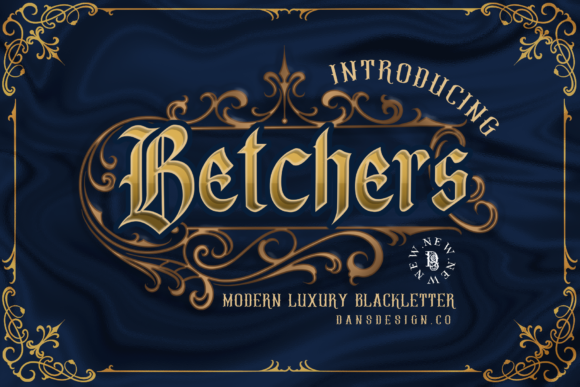
Blackletter typefaces, often referred to historically as Gothic or Old English, originate from the medieval period. They are characterized by their dense, intricate letterforms, sharp angles, and high contrast between thick and thin strokes. While many blackletter fonts lean heavily into archaic or aggressive interpretations, Betchers strikes a unique balance. It retains the structural integrity and ornamental quality associated with the style but refines these elements to appear more polished and less cluttered.
The "solemn" aspect of Betchers refers to its weight and presence. The letters command attention without shouting, providing a sense of authority and timelessness. Conversely, the "exquisite" nature comes from the finer details—the serifs, the crossbars, and the subtle curves that soften the rigid geometry typical of the genre. This duality makes it versatile enough for contexts that require dignity, such as legal documents or heritage branding, while also being striking enough for creative endeavors like album covers or fashion editorials.
- Visual Weight: Betchers possesses a heavy x-height and dense counters, which creates a strong visual block that stands out in large sizes.
- Ornamentation: Unlike stark gothic fonts, Betchers includes decorative flourishes that add a layer of sophistication.
- Versatility: Its refined edges allow it to pair effectively with cleaner, sans-serif body text, creating a balanced hierarchy.
Comparative Analysis: Betchers vs. Standard Display Fonts
When evaluating Betchers, it is helpful to compare it against other common display options. Designers often face a choice between highly legible sans-serifs, elegant serifs, and expressive display fonts like blackletters. Each category serves a different communicative purpose.
In comparison to standard serif fonts (such as Garamond or Caslon), Betchers lacks the neutrality required for long-form body copy. Serifs are designed to guide the eye smoothly across lines of text, whereas blackletters interrupt that flow intentionally. Therefore, Betchers should not be viewed as a replacement for traditional reading fonts but rather as a specialized tool for headlines, logos, and short impactful statements.
Similarly, when compared to modern sans-serif display fonts (like Futura or Helvetica Now), Betchers offers a completely different emotional tone. Sans-serifs communicate clarity, efficiency, and modernity. Betchers communicates history, craft, and exclusivity. If a brand identity relies on minimalism and speed, Betchers would likely work against those goals. However, if the goal is to evoke a sense of artisanal quality or dark luxury, Betchers provides a texture that sans-serifs cannot replicate.
Practical Use Cases and Application Scenarios
Understanding where Betchers fits in real-world scenarios helps clarify its value proposition. The font’s ability to convey both solemnity and exquisiteness opens up several specific use cases.
Tattoo Artistry and Body Modification
One of the most prominent applications for Betchers is in tattoo design. The intricate line work of blackletter fonts translates well to skin, offering a permanent, bold aesthetic. Because Betchers is refined, it avoids the "cartoonish" look that some heavier gothic fonts can produce. For individuals seeking a tattoo that looks sophisticated rather than aggressive, Betchers provides a timeless design element that ages well with the natural stretching and fading of skin over decades.
Premium Product Packaging
In the realm of consumer goods, packaging is the first point of contact. Betchers is particularly effective for products that want to signal heritage or premium quality. Think of craft beer labels, high-end whiskey bottles, or artisanal chocolate boxes. The font’s density adds a tactile feel to the visual experience, suggesting that the product inside is substantial and carefully crafted. It works especially well when paired with metallic foils or embossed textures, enhancing the luxurious appeal.
Editorial and Magazine Design
Magazines and zines often use display fonts to set the tone for articles or sections. Betchers can be used for pull quotes, section headers, or cover titles to inject drama and elegance. Its solemn nature lends itself well to serious journalism, true crime narratives, or historical retrospectives. However, due to its complexity, it should be used sparingly. Overusing Betchers in a layout can lead to visual fatigue, so it is best reserved for key focal points.
Brand Identity and Logos
For startups or established brands looking to differentiate themselves through a vintage-inspired identity, Betchers offers a strong logo foundation. It is memorable and distinct. However, scalability is a concern. At very small sizes, the intricate details of Betchers may blur or become illegible. Brands must consider whether their logo will primarily be used on large formats (billboards, storefronts) or small formats (mobile app icons, business cards). For digital-first brands, a simplified version of the typeface might be necessary.
Evaluating Tradeoffs and Limitations
No single typeface is perfect for every situation. When considering Betchers, it is crucial to acknowledge its limitations to avoid misapplication.
- Readability Constraints: As noted, Betchers is not suitable for body text. Its dense structure slows down reading speed. Using it for paragraphs will frustrate readers and reduce engagement.
- Cultural Context: Blackletter fonts carry historical baggage. In certain contexts, they can be associated with exclusionary groups or outdated colonial aesthetics. Designers must ensure that the use of Betchers aligns with the inclusive and respectful values of the brand or project. Modern refinement helps mitigate this, but awareness is key.
- Digital Legibility: On low-resolution screens, the fine details of Betchers may disappear. If the primary medium is web-based, testing the font at various screen sizes and resolutions is essential. Often, a lighter weight or a modified variant may be needed for digital adaptation.
Decision Framework: Is Betchers Right for You?
To determine if Betchers is the correct choice for your next project, consider the following decision factors. These questions help align the font’s characteristics with your specific needs.
What is the primary emotion you want to convey? If you are aiming for feelings of tradition, mystery, elegance, or seriousness, Betchers is a strong candidate. If you need to convey friendliness, approachability, or technological innovation, you should look toward rounded sans-serifs or geometric fonts.
Where will the text appear? Evaluate the size and context. Is this for a large-scale print piece, a logo, or a tattoo? If yes, Betchers shines. Is this for a website navigation bar, a mobile menu, or a quick-read email newsletter? If yes, Betchers is likely too complex and slow to read.
How will it interact with other elements? Betchers is a dominant typeface. It requires space to breathe and pairs best with minimalist supporting elements. If your design is already cluttered with patterns, images, and colors, adding Betchers may create visual chaos. Ensure there is enough negative space around the text to let its exquisite details stand out.
Conclusion
Betchers represents a sophisticated intersection of historical form and modern function. Its solemn yet exquisite appearance makes it a powerful tool for designers working in niches that value heritage, craftsmanship, and visual impact. By understanding its strengths in display applications—such as tattoos, packaging, and editorial highlights—and respecting its limitations regarding readability and digital scaling, professionals can make informed decisions that enhance their projects.
Ultimately, the choice between Betchers and other alternatives depends on the specific narrative you wish to tell. It is not a universal solution, but for the right context, it offers a level of distinction and character that few other typefaces can match. Careful consideration of audience, medium, and brand voice will ensure that Betchers serves as an asset rather than a distraction.